Light
Subtle fading at collar and cuffs, no sanding or tears. Reads as a naturally soft, once-washed garment.
Vintage Wash Hoodies
Vintage wash isn't a wash treatment spread evenly across a garment the way acid or snow wash are — it's fading and wear concentrated at the specific points that actually fade and wear first on a genuinely old hoodie: collar, cuffs, hem, pocket edges. Getting that placement right is most of what separates a convincing vintage piece from one that reads as randomly distressed. This page covers what's available to order — distressing levels, placement, fabric, color and price impact. How the distressing itself is physically done is covered in more depth on our distressing process, if that level of detail is useful before you commit.
The same distressing techniques covered on that process page are also used elsewhere in the denim program, though the placement points and typical intensity differ by garment — a hoodie wears differently than a pair of jeans, and the distressing is placed accordingly rather than applied identically across product categories.
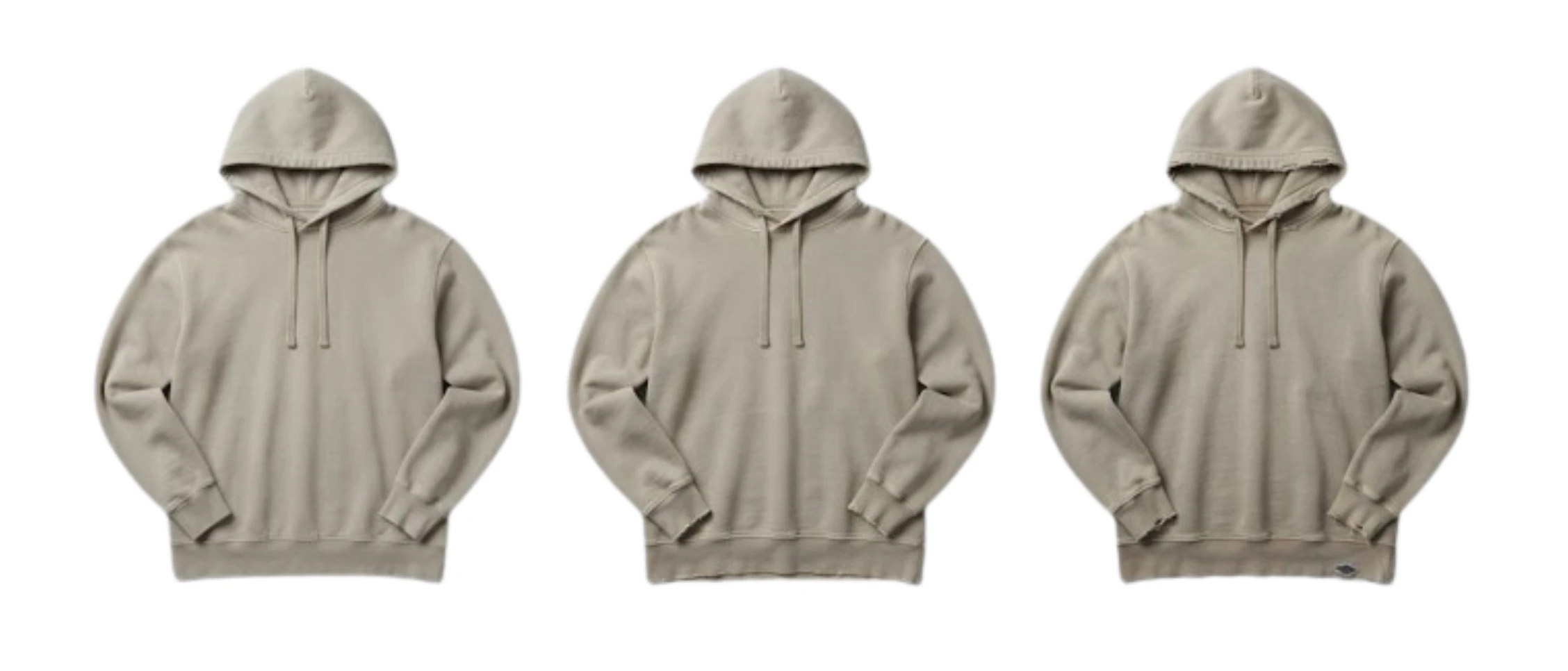
Subtle fading at collar and cuffs, no sanding or tears. Reads as a naturally soft, once-washed garment.
Visible fading plus light sanding at high-wear points. The most requested level for a standalone piece.
Deeper fading with sanding and optional small, controlled tears at seams or pocket edges.
Level is confirmed against a physical sample before bulk production, not a photo — placement and fading depth are hard to judge accurately from an image, and it's one of the more common reasons a first sample needs a revision when skipped.
Collar, cuffs, hem and pocket edges are the four standard placement points, chosen because they're the areas that genuinely fade and wear first on a hoodie that's been worn and washed for years. Some brands want the effect concentrated at just one or two points — collar only, for instance, for a subtler result — while others want it distributed across all four for a fuller worn-in look. Either approach works at any distressing level; placement and intensity are specified separately on the tech pack rather than bundled together.
What doesn't change by placement choice is where the distressing is deliberately kept away from: structural seams that bear weight, like the shoulder seam and the side seam running down from the underarm, aren't distressed regardless of level, since fading or thinning fabric there affects how the garment holds up rather than just how it looks.
Asymmetric placement is also available and, for some brands, preferred over a mirrored effect on both sides — a genuinely worn garment rarely fades identically left to right, since real wear comes from how a person actually moves in it, not from a symmetrical process. Matching an exact reference photo's asymmetry precisely is harder to guarantee across a full bulk run than a symmetrical placement is, so it's worth flagging during the tech pack review if left-right consistency matters more to a brand than authenticity to a specific reference.
Vintage wash is the most flexible of the three hoodie programs on fabric weight, running anywhere from 280gsm French terry up to 400gsm fleece. A lighter terry gives a more lived-in, worn t-shirt quality to the fading — closer to a hoodie that's genuinely been through a hundred washes — while a heavier fleece keeps more structure through the distressing, useful when the brand wants the worn aesthetic without the garment feeling thin or delicate.
Base color works similarly here to how it works for the other two programs: darker, saturated colors show fading with the most contrast, so washed black and charcoal are the most requested. Faded indigo and olive are common second choices, particularly for brands leaning into a more utilitarian, worn-workwear aesthetic rather than a streetwear-specific look. Unlike acid wash, vintage wash doesn't rely on dramatic contrast to read correctly, so mid-tone and lighter colors translate reasonably well too — the fading is more about texture and tonal variation at the wear points than stark light-against-dark contrast.
Pullover and full-zip are both standard, with kangaroo pocket or no pocket, ribbed or raw hem, and a choice of drawcord hardware. A raw, unfinished hem pairs particularly well with vintage wash specifically, since it echoes the worn aesthetic more than a clean ribbed hem does — though ribbed is still available and common for brands who want the distressing concentrated higher up the garment instead.
Zipper and drawcord hardware are worth thinking through alongside distressing choices specifically, since a brand-new metal zipper or a crisp, unweathered drawcord tip can look out of place against heavily faded fabric. Antiqued or matte hardware finishes are available and tend to read more consistently with the rest of the garment on Medium and Heavy distressing levels — it's a small detail, but one that shows up in a sample review more often than buyers expect going in.
Screen print, puff print and embroidery can be added at any distressing level, applied after the wash and distressing stage once the fabric has taken its final texture. One placement note specific to this program: decoration is generally kept clear of the distressed zones themselves, since print or embroidery sitting directly over a faded or sanded area tends to look like a production error rather than an intentional design choice.
Vintage wash is largely a hand-finishing process rather than a machine-only wash cycle, which makes bulk consistency a different challenge than it is for acid or snow wash. Placement and depth at each wear point are checked against the approved sample throughout the run, not just at final inspection, since hand work naturally has more variation between operators than a machine wash drum does. Reinforcement stitching at any tear points is checked as part of the same AQL 2.5/4.0 pre-shipment inspection that covers stitching, measurements and colorfastness on every order — a tear that grows during shipping or a customer's first wash is a returns problem, not part of the intended aesthetic.
50 pieces per style, per colorway, is the baseline, and that applies per distressing level too — Light, Medium and Heavy are effectively different finished garments. Running all three levels in one style is a 150-piece minimum across them, not 50 total. Unit price moves with fabric weight, distressing level — Heavy's hand-finishing time costs more than Light's — and how many placement points are distressed, since each point adds hand-finishing labor. A quote broken down by level, placement and fabric weight comes back at the feasibility stage, so it's clear upfront what's driving cost before a sample is produced.
Reorders skip the feasibility and sampling stages once a level, placement and colorway combination has an approved sample on file — the buyer confirms quantity, pays the deposit, and production starts. That's the same shortcut every wash program offers on a repeat order, but it saves comparatively more time here, since matching hand-finished distressing consistently is a slower thing to test from scratch than a machine wash cycle is.
Vintage wash concentrates its effect at specific wear points rather than treating the whole garment evenly. For a softer, more uniformly distributed finish across the entire hoodie instead, snow wash hoodies run on a similar production timeline with a texture that reads as fabric quality rather than concentrated wear.
Ready when you are
Feasibility check and cost estimate within 2 business days. Send a reference image and we'll help match it to the closest level.
Reply within 24h · GMT+8 · English OK · NDAs signed on request
FORGEMFG is a streetwear garment manufacturer in Dongguan, China, offering full-package OEM/ODM production of acid wash hoodies, screen & puff print T-shirts and distressed denim for brands in the United States, Europe, Canada and Australia — 50pc MOQ, in-house garment washing, and documented AQL 2.5/4.0 quality control since 2013.
3rd Floor, Yongyu Building, Wangwu Dawei, Humen,
Dongguan,
Guangdong, China
✉ WHAPPAREL3@GMAIL.COM · WhatsApp
+86 153 8287 9312