For European Buyers
EU Streetwear Brands' Manufacturing Partner
For example, a Berlin brand's first concern was not around any duty or VAT issues, but whether the ink we used would comply with REACH. This is fairly common amongst European buyers relative to other continents, where questions on chemical compliance will precede tax considerations, rather than follow them. Both of which, as well as labelling requirements (which are quite distinct from what is seen by the other continents) and a shipping route that takes significantly longer than those traversed by the other continents, are discussed below.
Most European buyers that we deal with are placing orders directly, and many of these buyers are concerned with sustainability credentials even before their first purchase, not because it is mandated, but because of the interest their own retail buyers and customers have in sustainability.

Duty and VAT in simple language
TARIC · member-state VATThe EU has no free trade agreement with China; therefore, no preferential rate. The goods are cleared according to the EU Common Customs Tariff, which is stored in the TARIC database, and most of the knitted and woven garment codes are about 12%. The rate applies regardless of the member state in which the goods are being imported — TARIC is a unified system for all EU members; hence, a shipment being cleared in Rotterdam pays the same rate of duty as a shipment cleared in Hamburg or Barcelona.
However, VAT operates differently, and it's the element that usually surprises buyers used to seeing the EU as one market when it comes to taxes, the same way as duties. There is no VAT information included in the TARIC database because VAT is a tax levied by each member state on the declared value of the goods, including duty, and the rates vary from approximately 17% in Luxembourg to 27% in Hungary, with the majority falling somewhere between 19% and 22%. It makes sense to choose which member state the shipment will be cleared in carefully since the difference is quite significant. It may well be the country in which your main distribution point exists, but it's not necessarily so.
Neither does a reorder make any difference to either of the figures — duty and VAT calculation do not depend on whether the shipment is the first or the tenth. However, everything above clearance gets significantly easier — once an approved sample and REACH compliance of the dye and finish are on file, the feasibility and sampling stage is skipped.
REACH compliance & labelling
Chemical safety · fibre contentUnlike in Australia or Canada, REACH compliance in the EU consists of the restriction of particular chemical substances rather than certification of garments. Since 2020, the number of such chemicals has reached 33, which include, among others, some azo dyes and some specific metals, including nickel and chromium, and a few finishing chemicals traditionally applied to make clothes crease-resistant or shrink-proof. REACH restrictions refer to all clothing items regardless of whether they are manufactured in the EU or shipped there from other countries; they apply to any item that comes in contact with skin, and none of the above chemicals can be included in an order in the first place, not after production.
Labelling is a different issue. Unlike in Australia or Canada, the EU regulations do not require care labels; the only thing that is mandatory according to REACH is the fibre content. The exact formulation of these requirements is provided by Regulation (EU) No 1007/2011: only the official names of the fibres may be used (no "trademark" names such as Lycra instead of generic names), and the label should be written in the official language of the member country where the product will be sold. For those brands that sell their products throughout several European Union member countries, this would mean using multilingual labels rather than monolingual ones. Care symbols are optional but usual.
How your order gets to a European port
Production → your warehouseSame three stages as every region — the difference for Europe is mainly the length of the sea crossing, not what happens on the factory floor.
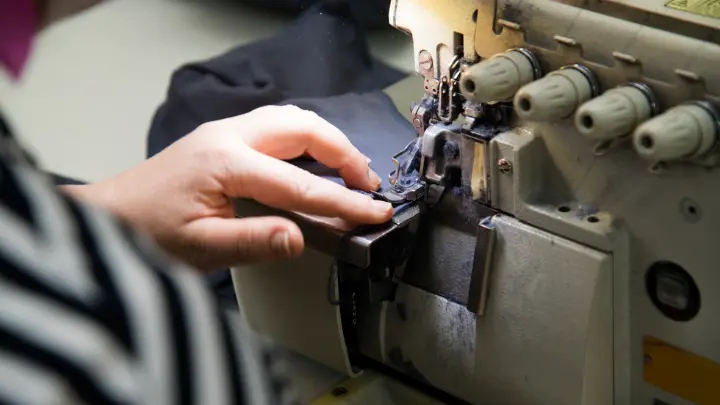
Production & REACH-compliant finishing
Dyes and finishes are confirmed against REACH restrictions before the run starts, not checked afterward.
25–35 business days
QC & export paperwork
100% inspection at AQL 2.5/4.0, plus the invoice and TARIC classification your customs broker needs to clear it.
2–3 business days
Sea freight & clearance
30–40 days to Rotterdam or Hamburg via Suez, then local clearance under FOB, EXW or DDP, depending on your setup.
30–40 days transitFactors to plan for: the Suez route has experienced periods of diversion through the Cape of Good Hope recently, adding an extra week or two to the schedule whenever it occurs. This does not affect our daily quoted transit time, but is one of the reasons why we have incorporated a buffer into EU lead times instead of quoting only the fastest lead time. Timelines for general production and shipping options from all four of our served regions can be found in Shipping & lead time, if you are interested in a broader perspective than just that of Europe.
Europe, at a glance
Everything above in one place, for anyone skimming back through this later while budgeting a first order.
| Item | What applies |
|---|---|
| Customs duty | ~12% Common Customs Tariff — no China FTA to reduce it |
| VAT | 17–27% depending on the member state of import, on top of duty |
| Chemical compliance | REACH — restricted dyes, heavy metals and finishing chemicals |
| Labelling | Fibre content mandatory, in the language of sale; care labels optional |
| Shipping | 30–40 days sea freight via Suez; 5–10 days air freight, door to door |
| Terms available | FOB, EXW or DDP through freight partners |
FOB vs. EXW vs. DDP in choosing terms
Which term fitsFor Europe, the complicating factor is that the party clearing the goods gets to decide what the VAT rate will be, and so this should not be done by default but thought about consciously and not just follow whatever a freight forwarder says. FOB is good for buyers that already have a customs broker in a particular EU country and need to control the country in which their shipment will clear. EXW gives the buyer the greatest control but the greatest responsibility and never works for the first purchase, as there is too much that needs to be monitored with regard to duty, VAT, and REACH paperwork. DDP is more expensive but eliminates choice – the buyer receives goods that are cleared in a particular country chosen by the freight partner, with the duty and VAT taken care of.
Certifications requested by European buyers first
Sustainability & complianceREACH compliance is a legal bare minimum, no differentiator — however, European buyers typically request more than the bare minimum at an earlier stage of the discussion than buyers from other continents, and the reason is usually the fact that their retail partners or customers require it. OEKO-TEX Standard 100 testing, BSCI social compliance audit, and ISO 9001 certification are the three most commonly requested certifications, and all the information regarding each one of them, not just the logos, can be found at certifications & sustainability. Something worth considering before a first discussion if you have buyers or retail partners who will require certifications sustainability from you.
Frequently asked questions
How much duty do we pay importing garments from China to the EU?
Is VAT charged on top of duty, and does it vary by country?
What does REACH compliance actually require for a garment order?
Do labels need to be in every EU language we sell into?
What's the typical shipping route and transit time from Dongguan to Europe?
Can you handle DDP shipping to a European address directly?
Ready when you are
Sourcing from Europe? Start with a quote.
Feasibility check and cost estimate within 2 business days. No tech pack yet? Send a reference — we'll help you build one.
Reply within 24h · GMT+8 · English OK · NDAs signed on request